 +1 (989) 614-0089


The One Thing You Should Never Do on Your Ecommerce Product Pages
Hey there! Alex from Build Grow Scale here. I’m a Revenue Optimization™ expert, and I help ecommerce businesses grow and scale through optimizing their store.
In this article, I’m going to share the one thing you should never do on your ecommerce store’s product pages. It’s actually something that’s accepted as a must-have in the industry … But, in fact, it’s one of the biggest mistakes that ecom businesses make!
So, what is this “one thing”? Drumroll, please …
It’s having social sharing icons on your product pages.
There are two main reasons why you want to avoid doing this at all costs:
- Nobody actually cares about sharing your product … at least not yet. Why would someone want to share your product with their close circle of friends when at this stage, they don’t even know if they themselves like your product or not?
- You’ve paid a lot of money to get them to your product pages from Facebook, Google, or wherever. So, why would you give them an easy way out and back into their favorite social networks where it’s going to take only a second for them to go down the rabbit hole and never return?
OK, so let me share my screen and we’ll go through a few examples:
Example 1
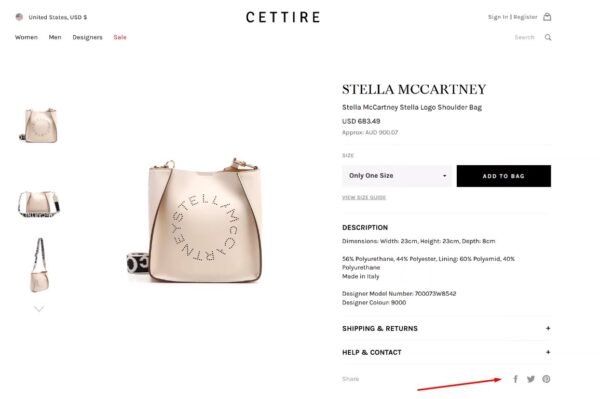
If I click on one of the social sharing icons in the screenshot below, it will take me to Facebook/Twitter/Pinterest, where I can post it on my personal profile, depending on what pages these businesses enable.
Example 2
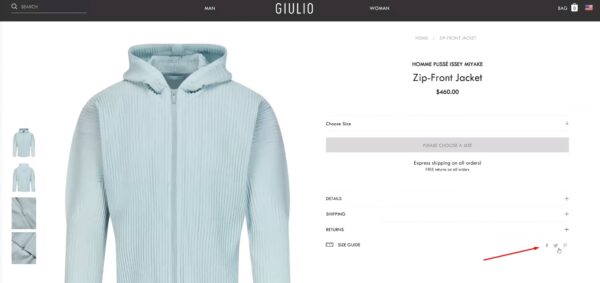
The social sharing icons on this page are a little bit smaller so it’s not quite as prominent but still noticeable and risking taking the customer away from the site.
Example 3
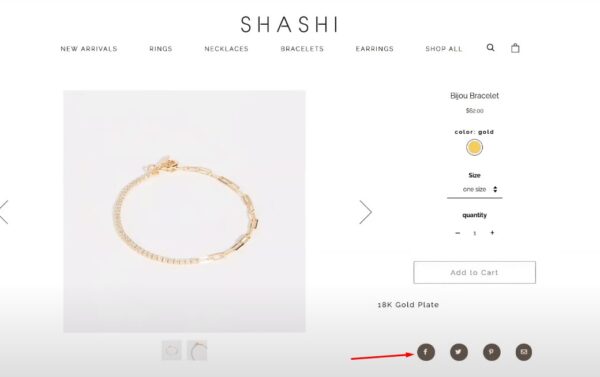
But now look at the product page below. These social sharing icons literally stand out more than the “Add to Cart” button (the one action you want people to take on this page)! This is a huge no-no and super distracting. The ATC button should always be the most prominent element on your product page.
Side note: Their ATC button also happens to be a “ghost button,” which is another thing you should never do.
Example 4
In this next one, look how BIG these social sharing buttons are. They’re not even icons, they’re actual “buttons.” Why would you give your visitors buttons to share a product they can’t possibly know they like yet instead of showing them relevant information that will push them toward the sale? It doesn’t make any sense.
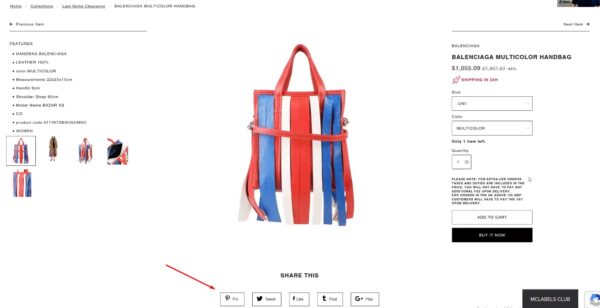
Example 5
OK, here’s the last one. You’ll notice that the social icons on this product page are right below the “Buy it now!” button (which is another thing you shouldn’t do because it’s asking for too much commitment—stick with “Add to Cart”). You do not want to do this; it’s extremely distracting to your customers.
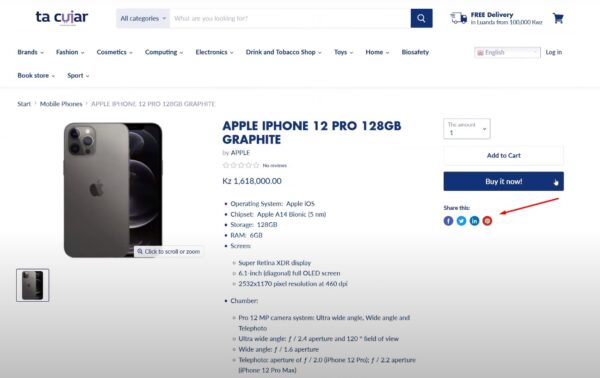
By the way, all five examples I’ve shown you are from websites that are top Shopify stores (holding spots ranging from #1 to #9) based on traffic volume as of April 7, 2021.
The Lesson
What we can learn from the fact that the top Shopify stores are making such a huge mistake on their sites is this: Don’t blindly copy other ecom stores just because they’re big, popular, or get a lot of traffic. Because being well-known or “at the top” doesn’t mean they’re doing everything the right or most profitable way. So, you always want to be guiding yourself by data and testing.
If You Just Can’t Resist
Now, if you feel you absolutely cannot live without having social sharing icons on your store’s website, where is the best place to put them? The answer is on your thank-you page … because by the time someone reaches this page, they actually have a reason to share a product. They’ve invested in it, they’re excited about their purchase, and are therefore more compelled to share it with others.
In fact, a really good thing to do on your thank-you page is incentivize your customers to share your product on social media. Give them something like a discount or gift card, or whatever works for your business, in exchange for sharing. This can work really well if done correctly.
Note: You can also display social sharing icons in your transactional emails, email receipts, and email order confirmations.
Recap and Wrap-up
So let’s recap what we’ve learned today:
- Never show social sharing icons on your product pages.
- Do show social sharing icons on your thank-you page, email receipts, and order confirmations.
- Incentivize customers to share your products on social media to get a ton of eyeballs on them and free traffic to your store.
- Don’t blindly copy other ecommerce stores just because they’re big, popular or well-known because that doesn’t necessarily mean they know what they’re doing.
OK, that’s it for today! If you liked this training and want to learn more about Revenue Optimization™ or working with Build Grow Scale, you can go to workwithbgs.com and schedule a free strategy call with one of our experts. We’d love to hop on a call with you to see how we can help build, grow, or scale your ecom business.


About the author
Aleksandar Nikoloski
Aleks is BGS’s Head of Revenue Optimization, an author, and a speaker. He has helped rapid-scale dozens of 6, 7, and multiple 8-figure stores as part of BGS’s Amplify Partnership program. He has gotten one store from $2.6 million a year to $6.7 million a year in 24 months, while another from doing $300k/month to doing over $2 million/month in less than 6 months, just to mention a few. The BGS team calls him the “Site Whisperer” because of his ability to find site nuances that derail the customers’ journey and cause purchase friction. Extremely meticulous and analytical, he credits all of this success to data and accurate interpretation of that data, as well as his ability to implement and test new ideas almost immediately.